
Fire safety guidance has expanded rapidly in recent years. Since 2017, thousands of pages of legislation and regulations have been introduced across the UK.
For design teams, this presents a difficult challenge. The sheer volume of information can be daunting, and make it harder to make decisions with confidence, particularly on complex or high value schemes.
It’s easy to get lost in the details. Teams often find themselves navigating clauses, definitions or overlapping guidance just to stay compliant. While this work is important, it can start to dominate the process, and leave other factors neglected.
When regulatory noise starts to overcrowd judgment, it’s important to bring yourself back to the original question – what is the building trying to achieve in terms of fire safety?
Where projects start to struggle
With so much guidance available, it’s natural to focus on compliance at a detailed level.
This often leads to long discussions around wording, definitions and interpretation. While they have their place, they can start to pull the attention away from how the building will actually perform in a fire.
Design teams can lose momentum as decisions become harder to make or justify. Coordination between disciplines becomes more difficult, and sometimes causes conflicts when different interpretations of guidance oppose. Time is spent resolving data rather than progressing overall strategy.
In some cases, this leads to overly cautious or overly complex solutions that don’t necessarily improve safety, but have an impact on buildability, fire safety management complexity, cost, and often an objectively poorer level of building fire safety performance.
At its worst, the fire strategy itself can become fragmented, with individual elements considered in isolation rather than as part of a coherent whole.
The real objective of fire safety
At its core, fire safety is about outcomes rather than interpretation of generic guidance. A well designed building should be able to answer a few straightforward questions, such as:
Can people evacuate safely?
This comes down to more than travel distances of exit widths. There’s added nuance behind how people behave, how clearly escape routes are understood, and whether the design supports a calm and efficient evacuation for a wide range of users, including those with limited mobility.
Do fire protection systems support an evacuation?
Passive and active measures need to work together. Compartmentation, structure and fire stopping should limit the spread of fire and smoke, while fire detection, alarm and suppression systems give occupants time to respond. Focusing on one without the other can weaken and fragment the overall strategy.
Can the fire and rescue service operate effectively?
Access, water supplies, firefighting shafts and internal layouts all influence operational firefighting tactics by the fire and rescue service. These are practical considerations that affect real world outcomes in a fire emergency.
Does the design reflect the level of risk?
Risk is influenced by many factors, including use, occupancy, layout and management. Unfortunately, building height is increasingly considered a direct proxy for risk. A more rounded view of the risk level is required to enable the fire strategy to respond to how the building will actually be used.
These principles sit behind the guidance set out in documents such as Approved Document B and standards like BS9991, which support compliance with the Building Regulations 2010.
Guidance helps structure decisions, but it cannot fully define how every building should perform. That still relies on robust fire engineering judgment and a clear understanding of the overall objective.
Using a holistic approach
Fire safety does not sit within one document or discipline. It’s shaped by a series of decisions made across the design, construction, and use of a building. These decisions only work when they are considered together.
The three core factors to consider are:
- Passive measurements such as compartmentation and structure
- Active systems such as alarms and suppression
- Management and maintenance over time.
Each plays a role, but none of them work in isolation. Gaps in coordination between these elements are often where issues arise.
These three factors are brought together under the functional requirements of the Building Regulations 2010, which are intended to be met as a complete system rather than a checklist.
No single guidance document can fully reflect the range of building types, layouts and uses seen in practice. This is why a joined up approach matters. Stepping back to consider how the building performs as a whole often leads to clearer, more robust design solutions.
Instead of asking how a particular clause in guidance may apply, the more useful question is whether the design achieves the right outcome, as reflected in the functional requirements of the Building Regulations.
A more practical way forward
For most projects, clarity comes from stepping back early and setting a clear, coordinated strategy before the design becomes too fixed.
A few key steps to consider include:
Defining the fire strategy objectives at the start of the design process.
This gives the team a shared direction from day one. It helps guide key decisions around layout, access and building use, rather than trying to justify them later.
Looking at the building as a whole, rather than as isolated elements.
Fire safety works best when it’s considered alongside how the building is planned, used and constructed. This avoids situations where compliant elements don’t quite align when brought together.
Using guidance to support decisions, not drive them.
This point is key. Guidance remains essential, but it works best when applied with a clear understanding of the intended performance outcome. This allows teams to use it with confidence, rather than feeling constrained by it.
Coordinating fire strategy alongside acoustics, building physics, and facade design.
Many of the same building elements influence multiple platform requirements. Considering these togethers helps reduce clashes and leads to more efficient, buildable solutions.
When fire strategy is considered alongside the wider design, it becomes part of the decision making process rather than a layer added later, or reliance on a report to justify poor design decisions.
This reduces the risk of late changes, helps avoid conflicting requirements, and gives the project team a clearer path through an increasingly complex regulatory landscape.
How integrated design helps
An integrated consultancy approach can streamline the design process, save time and costs, and enhance project outcomes.
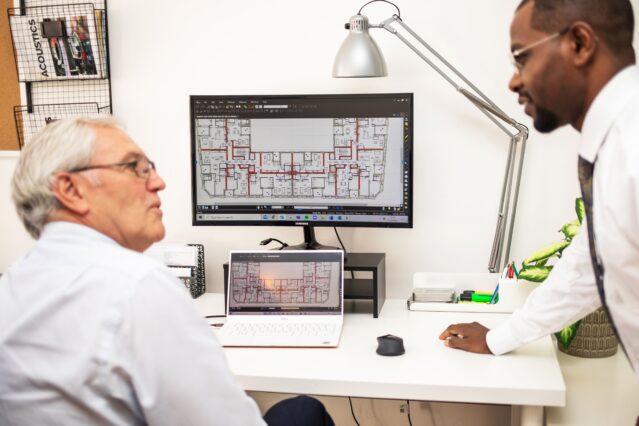
Considering other disciplines such as acoustics, facade design and building performance from the outset, decisions tend to be more balanced and easier to coordinate. The design develops with a clearer understanding of how different requirements interact, rather than siloed development that leads to later conflicts.
This approach helps maintain focus on the overall objectives of all disciplines. Instead of navigating guidance in isolation, the project team can work with a clearer strategy that reflects how the building is expected to perform as a whole.
For clients and design teams, this creates a more straightforward route through what can otherwise feel like a complex and fragmented process.
A clearer way through fire safety complexity
Fire safety guidance will continue to evolve, and the volume of information is unlikely to reduce any time soon.
With the right approach, it can be managed in a way that brings clarity rather than confusion. Focusing on outcomes helps keep decisions grounded in how a building will actually perform. Asking the right questions early gives design teams a clearer direction. And taking a coordinated approach reduces the risk of conflict between disciplines as the project develops.
With in-house specialist teams working across acoustics, fire engineering, facade, building physics, and building surveying, Cahill Design Consultants delivers an integrated approach to consultancy. We support earlier decisions, reduce coordination risk, and help to keep projects moving forward with confidence. If you are working on a scheme and want to take a more integrated approach to fire safety, acoustics or facade design, the team at CDC are always happy to have a conversation. Give us a call on +44 (0) 1206 809598 or leave us a message.